Lawyer Paul Martin had eventually responded in February 2026:
On Tue, 3 Feb 2026 at 09:09, Martin, Paul <paulmartin@wirral.gov.uk> wrote:
Dear Mr Cardin
Apologies that you have not received a more timely response to your attempts to contact me. I was advised by colleagues that a response from the Council had been provided to you by Mandy Lewis, Assistant Director and Chief Planner, in addition since my correspondence with you on the matter of 5G masts commenced a Senior Planning Lawyer, Nicky Folan, has been appointed within the Council’s Legal Services Team and as your latest queries are more specific in respect of the Planning process it would be more appropriate for my colleague to respond to the points you raise. As such I have passed the relevant correspondence on to my colleague who will respond to your points in due course.
Yours sincerely
Paul Martin
Principal Lawyer: Litigation & Governance
Wirral Council
Law and Corporate Services
PO Box 290
Brighton Street
Wallasey
CH27 9FQ
Tel: 0151 666 3649
Email: paulmartin@wirral.gov.uk
Visit our website: www.wirral.gov.uk & www.wirralview.com
I’d prompted Senior Planning Lawyer Nicky Folan with the following email around two months before she initially responded:
From: Paul Cardin
Date: Wed, 11 Feb 2026 at 21:05
Subject: Re: The law / UK courts / public safety
To: <nicolafolan@wirral.gov.uk>
Cc: Kelly, Stuart E. (Councillor) <stuartkelly@wirral.gov.uk>, Foulkes, Steve (Councillor) <stevefoulkes@wirral.gov.uk>, Gorman, Harry R. (Councillor) <harrygorman@wirral.gov.uk>, Gardner, Andrew M. (Councillor) <andrewgardner@wirral.gov.uk>, Kenny, Brian M. (Councillor) <briankenny@wirral.gov.uk>, Hodson, Kathy. (Councillor) <kathyhodson@wirral.gov.uk>, Powell-Wilde, Sue (Councillor) <suepowellwilde@wirral.gov.uk>, McManus, Grahame (Councillor) <grahamemcmanus@wirral.gov.uk>, Walsh-McDonald, Jason <jasonwalshmcdonald@wirral.gov.uk>, Jordan, Mary (Councillor) <maryjordan@wirral.gov.uk>, Stuart, Kaitlin (Councillor) <kaitlinstuart@wirral.gov.uk>, <mandylewis@wirral.gov.uk>, Martin, Paul <paulmartin@wirral.gov.uk>
Dear Nicola Folan,
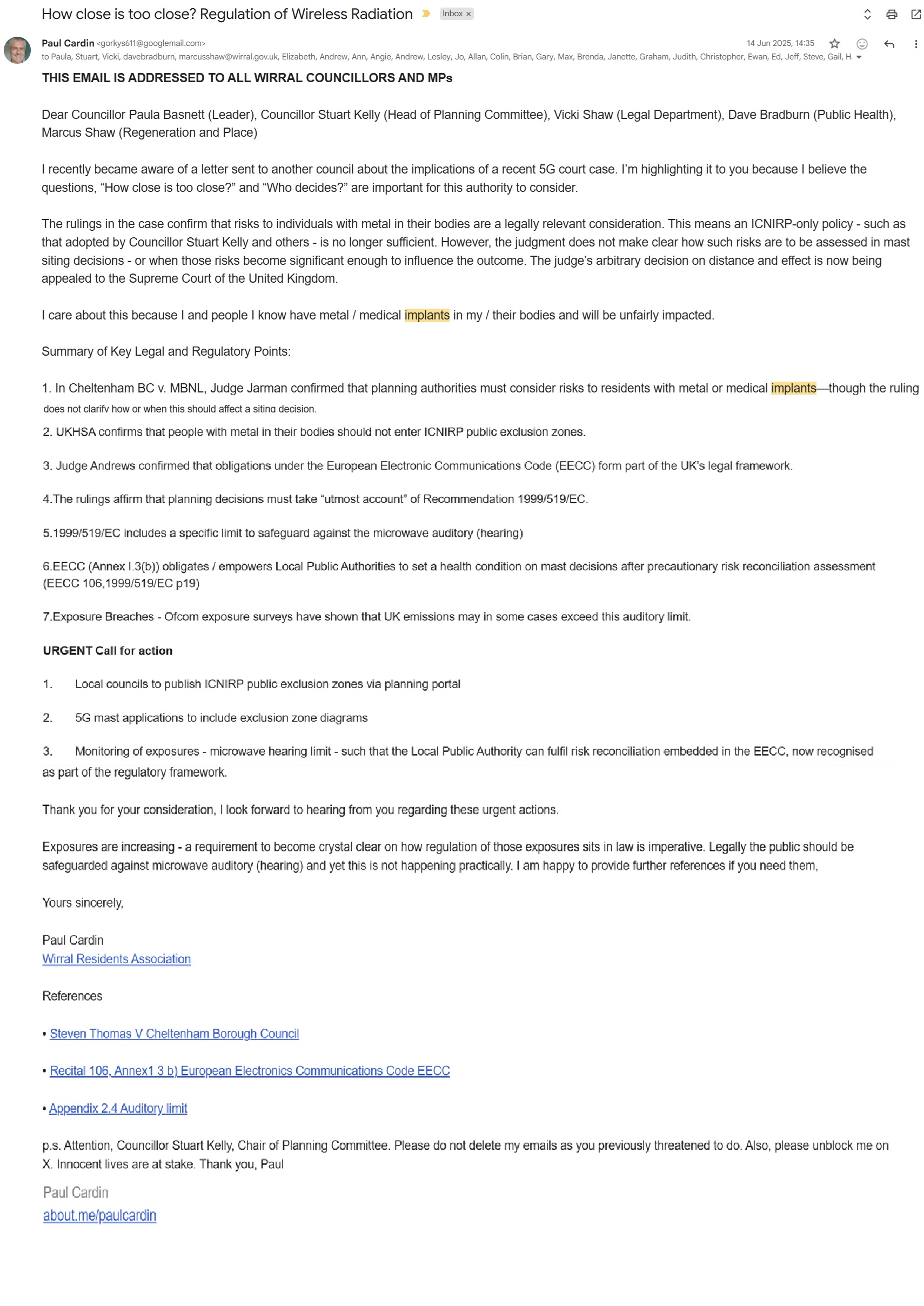
In furtherance of my case, and further to my recent response to your colleague Paul Martin, please find attached some highly relevant and informative information regarding:
A. Three UK (company) bogus ICNIRP safety certificates, courtesy of expert Ian Jarvis of Aches International
B. The Cheltenham Council High Court victory for Stephen Thomas, including medical / metal implants
I look forward to hearing from you, as referred to within Paul Martin’s email of 3rd February 2026.
Best regards,
 | Paul Cardinabout.me/paul.cardin |
The attachments:
Her response arrived on 13th May 2026, 11 months after my original email.
From: Folan, Nicky <nickyfolan@wirral.gov.uk>
Date: Wed, 13 May 2026 at 16:01
Subject: RE: The law / UK courts / public safety
To: Paul Cardin
Dear Mr Cardin,
As you are aware your emails to Mr Martin have been forwarded through to me to provide a response, and apologies for the time it has taken for me to reply.
As the Local Planning Authority, the Council is required to deal with planning applications that are submitted to it in accordance with the development plan unless material considerations indicate otherwise, and in accordance with the National Planning Policy Framework. The Council also ensures that it is aware of changes in interpretation that occur as cases raising specific issues are progressed and determined through the Court system.
You refer to the case of Thomas v Cheltenham BC which was heard by the High Court and then appealed to the Court of Appeal, with the Court of Appeal giving judgment on 13 March 2025. Permission was sought to appeal the Court of Appeal decision, but this was refused by the Supreme Court in July 2025.
The Court of Appeal were clear in their decision that the potential impact of EMF’s on pacemakers or other implants were not always material considerations in applications of this nature, but that the potential impact of EMFs on medical implants was information that a decision-maker could have regard to if in their judgement they thought it right to do so. The Council as Local Planning Authority has discretion to determine whether issues raised during the consideration of a planning application are material considerations or not, and if they are, what weight should be afforded to them. The impact of EMFs on medical implants is capable of being a material consideration on the facts of a particular case, but it is for the Council as decision maker to look at representations made and consider the basis and evidence behind comments, and to then determine if they are a material consideration and the weight to be given.
The judgment makes it clear that there will be circumstances where the effect on implants is not a material consideration, but there may be cases where it is- each case will be fact specific and will need to be dealt with in an appropriate way dependant upon those facts. It is therefore incumbent upon the Council as Local Planning Authority to be aware of this issue and to react accordingly, as it must when any health-related matters are raised about any development that is proposed. The Planning Officers are aware of this requirement and will continue to act in accordance with this and other judgments of the Court.
With reference to your comments on the ICNIRP certificates, and the information that some certificates appear to have been incorrect, I will ensure that the Planning Officers are aware of this issue.
As I am sure you are aware, the National Planning Policy Framework sets out clearly how it is expected that Local Planning Authorities will process applications for electronic communications development. The Council must take into account that guidance and cannot set health safeguards different from the International Commission guidelines. To do so would be to act in a way that would be challengeable.
I note that you refer to potential Judicial review of some 5G mast installations, and I am unable to comment on that point. You would need to take your own legal advice, and the Council will respond as required to any judicial review received.
Kind regards
Nicky
Nicky Folan
Senior Planning Lawyer
Wirral Borough Council
Law and Corporate Services
P.O. Box 290
Brighton Street
Wallasey
CH27 9FQ
The Wirral Residents Association responded to this email on 18th May 2026:
———- Forwarded message ———
From: Paul Cardin
Date: Mon, 18 May 2026 at 18:22
Subject: Re: The law / UK courts / public safety
To: Folan, Nicky <nickyfolan@wirral.gov.uk>
Cc: Martin, Paul <paulmartin@wirral.gov.uk>
Dear Nicky Folan,
Thank you for your emailed response.
Public authorities have a clear duty to act with caution when there is credible scientific evidence of harm. Failure to do so risks not only public health but also institutional accountability and the confidence of the local community. 9.4 EECC – Competent Authority and Public Health Considerations. Under the European Electronic Communications Code (EECC) (part of UK law), mobile network operators are legally duty-bound to consider public health, safety, and environmental factors when deploying or operating networks. The planning process should therefore assess whether there are credible public health concerns, especially where vulnerable populations such as children at nearby schools are affected. An application should not be accepted on the basis of a tick-box ICNIRP declaration alone when there are unresolved scientific and community concerns regarding environmental exposure. A genuine public health assessment under EECC duties would need to consider potential cumulative exposures, vulnerable groups, and emerging scientific evidence, not merely thermal compliance with ICNIRP exposure limits. When these regulatory failures, omissions, and unresolved public health concerns are considered alongside the actual siting of the proposed mast, it becomes clear that this is not a theoretical risk but a real and immediate exposure scenario affecting children, families, and the wider community.
Reliance solely on ICNIRP guidance does not guarantee protection of public health. Authorities retain discretion to weigh official guidance against credible evidence submitted by the public or other interested parties. Solicitors to PHE/UKHSA advised that public bodies must exercise judgment about how much weight to give ICNIRP-based guidance and other evidence, and that any legal risk from decisions rests with the public body, not with ICNIRP or the guidance itself: https://aches.international/wp-content/uploads/2025/01/Letter-to-Minister-for-DigitalCulture_5G-
liability.pdf
Local authorities also have statutory duties under UK law. These include obligations under the Health and Care Act 2012 to take steps appropriate to improve public health, under the Town and Country Planning Act 1990 to consider all material considerations including emerging scientific evidence and health risks, under the National Planning Policy Framework 2021 to promote healthy and safe communities, particularly for vulnerable groups, andunder the Equality Act 2010 to consider impacts on individuals with protected characteristics, including children, pregnant women, older adults, people with medical implants, and those with electromagnetic hypersensitivity.
As you will be fully aware, planning officers must comply with the NPPF and planning material considerations as an intrinsic part of their public role.
Planning officers are relatively powerful and retain their ability to make judgements based on the merits of each case as part of a Planner’s role. Cases are unique and many cases are processed under the delegated decision-making power granted to them. Inevitably, they may make wrong decisions and, if they do, checks and balances may come in the form of appeals and / or legal challenges. No challenge equals no problem, equals no change. I challenge the Council’s framing that ICNIRP compliance constrains them from considering EMF impacts on medical and metal implants such as pacemakers, since the courts have explicitly found the opposite.
I challenge your response on five specific grounds, all based on verified case law:
The five challenges raised are:
1. Who sought Supreme Court permission — Your letter states “permission was sought…” without identifying by whom, potentially creating the false impression the matter was being challenged by Cheltenham Council. In fact it was Mr Thomas (the original claimant) who sought permission as Appellant (UKSC/2025/0066), and it was refused on 30th July 2025. The Council had won in the Court of Appeal and had no reason to appeal.
2. The Planning Officer’s legal error — The Court emphasised that the Planning Officer misunderstood paragraph 118 of the NPPF, wrongly believing that compliance with ICNIRP guidelines barred consideration of the potential impact of EMFs on medical implants, and this misapprehension led to a failure to independently consider whether that concern was a material consideration. Your response never mentions this error, which is the central lesson of the case for planning officers. CaseMine
3. The ICNIRP “cannot deviate” argument is legally wrong — The ICNIRP guidelines explicitly exclude interference with medical implants from their scope, which is managed by medical professionals and is outside the guidelines’ scope. The Council’s claim that it “cannot set health safeguards different from” ICNIRP restates the exact error the courts condemned. CaseMine
4. Inadequate response on potentially fraudulent certificates — Merely “making Planning Officers aware” of potentially fraudulent self-certifications is insufficient if past decisions may have been made on a false basis.
5. No concrete procedure stated — Your letter gives no details of how future representations about medical implants will actually be handled, beyond vague assurances.
I also refer you to ACHES Letter 9 (attached) for your consideration, which refers to ICNIRP compliance for 5G installations.
Also in ACHES Letter 9 is a key statement regarding exclusion zones and UKHSA. Has Wirral Council ever canvassed their residents to locate AIMD wearers and inform them of the 4G exclusion zones?
Furthermore, have you ascertained the 5G antenna details for 5G exclusion zones in the light of Ericsson’s and Nokia’s statements referred to in Letter 9?
The Thomas case can be viewed very differently in terms of precedent. Cheltenham Borough Council (CBC) completely failed in their attempt to overturn in the Appeal Court the Judge Jarman ruling in the Thomas v CBC High Court case. That ruling is that a Council will fail if it does not take into account people with AIMDs living proximal to such a mast. That salient ruling is extremely potent and remains.
Councils cannot have it both ways – namely to rely on ICNIRP when it suits them and to not rely when it doesn’t.
ICNIRP states clearly that AIMD wearers and the like, are outside the scope of ICNIRP and are not protected by it.
Therefore, in terms of equality law, Wirral Council must take appropriate measures. Judge Jarman’s High Court ruling states the same. What steps have Wirral Council taken in this respect? If none, can that be lawful?
Finally, I believe you are wrong in your conclusion about setting different health standards over AIMDs as these are clarified in the ruling on the Steven Thomas case. Please take time to review this separately. From now on certainly, these should feature in planning officers’ deliberations and if they feel they do not apply, relevant reason(s) should be stated.
I believe that the new information I bring should be applied retrospectively to completed telecoms installations because this challenge amounts to proof that Wirral Council planners have erred. Your failure to mention the Cheltenham planning officer’s legal error and the inadequate response on fraudulent safety certificates does not augur well and raises the potential for foreseeable, avoidable future errors.
I look forward to a timely, detailed and comprehensive response; one containing future corrective commitments, which are made in the vital, compelling and broader interests of restoring and advancing public health.
My enquiries began in August 2025, and it has taken 9 long months for your eventual response to arrive. Please do not allow my ongoing correspondence to be left on one side, forgotten / unaddressed, as seems to have occurred in the past,
Best regards,
Paul Cardin
On behalf of the Wirral Residents Association
| Paul Cardin about.me/paul.cardin |
Here is the ACHES Letter 9 attachment:
And bringing us right up to date, here is the emailed response received from Nicky Folan on 17th July 2026:
———- Forwarded message ———
From: Folan, Nicky <nickyfolan@wirral.gov.uk>
Date: Fri, 17 Jul 2026 at 17:08
Subject: RE: The law / UK courts / public safety
To: Paul Cardin
Cc: Martin, Paul <paulmartin@wirral.gov.uk>
Dear Mr Cardin,
Thank you for your further email and queries.
My initial response confirms that the Court of Appeal judgment states that there will be circumstances where the effect on implants is not a material consideration, but there may be cases where it is- each case will be fact specific and will need to be dealt with in an appropriate way dependent upon those facts. This is the way that cases will be dealt with by the Development Management Team going forward and is something that Planning Officers have been notified they must do and are used to doing. Each application that they process is different, they have to look at the specific facts of that case and apply relevant policy and case law to that given circumstance. There are numerous planning cases each year that can alter the way that applications being processed need to be dealt with by the Planning Officers, so the application of the law as set out by the Court of Appeal judgment is not unusual or difficult for the Planning Officers to undertake.
I had not intended to create a false impression in terms of the appellants in the Court case, ultimately the decision of the Court of Appeal stands and must be complied with whoever brought the challenge that led to that decision.
The Council as Local Planning Authority, and the Planning Officers dealing with such applications are aware of the ruling of the Court of Appeal, and of the specific fact that the effect of a development upon implants can be a material consideration based upon the facts of the case so is something that they need to respond to. I would reiterate that the Planning Officers will act in accordance with this and other judgments of the Court that relate to their assessment of planning applications. Planning Officers will comply with the NPPF, national planning guidance and planning material considerations as part of their role and are aware that they can consider evidence of potential interference with pacemakers and other AIMDs as a valid material consideration and appropriate weight should be given to this in decision making.
The assessment of a planning application, the balancing of material considerations and the weight to give each of those material considerations sits alongside the ICNIRP compliance certificate that is required to be submitted when an application for telecommunications equipment is made. Neither replaces the other. This balancing of material considerations will take place in an officer report as part of the officer assessment of the application.
The Council is required to comply with the National Planning Policy Framework, which has a specific section on communications infrastructure, there is also Policy WD13 on telecommunications Development within the Local Plan that was adopted by the Council in March 2025. In terms of telecommunications applications into the future, the Council and its Planning officers will continue to apply that policy to the applications and facts in front of them, taking account of any relevant court decisions.
The Code of Practice for Wireless Network Development in England, provides guidance to code operators and other stakeholders on how to carry out their roles and responsibilities when installing wireless infrastructure. This sets out a number of principles related to consultation, including situations where pre-application consultation with local communities should take place, and acknowledging that Local Planning Authorities must consult prior to determining planning applications submitted to them. The level of consultation is advised to be determined on a case-by-case basis as it is dependant upon a number of factors that vary site by site. No generic consultation regarding the location of AIMD wearers is required to be undertaken.
The steps that I have outlined above are the steps that have been put in place following the decision of the Court of Appeal; Planning Officers have been made aware of the decision and how it affects their assessment of a planning application, with clear instructions that evidence of potential interference with pacemakers and other AIMDs is a valid material consideration and appropriate weight should be given to this in decision making.
As I confirmed previously, the Planning Oficers have also been notified that some ICNIRP certificate information previously appears to have been incorrect and are monitoring this to ensure it does not happen again.
Unfortunately, the effect of Court cases and any changes in policy are not able to be applied in retrospect and therefore while future applications raising evidence of potential interference with AIMDs will be dealt with as set out above, it is not possible to re-assess previous applications in this way.
Kind regards,
Nicky
Nicky Folan
Senior Planning Lawyer
Wirral Borough Council
Corporate Services
P.O. Box 290
Brighton Street
Wallasey
CH27 9FQ
Tel: 0151 666 3082
Email: nickyfolan@wirral.gov.uk
Visit our websites: www.wirral.gov.uk & www.wirralview.com
Wirral Residents Association’s response was sent the following day:
———- Forwarded message ———
From: Paul Cardin
Date: Sat, 18 Jul 2026 at 19:55
Subject: Re: The law / UK courts / public safety
To: Folan, Nicky <nickyfolan@wirral.gov.uk>
Cc: Martin, Paul <paulmartin@wirral.gov.uk>, <merseysiderainfo@gmail.com>
Dear Nicky Folan,
Thank you for your correspondence detailing the Council’s proposed approach to telecommunications planning applications following the landmark Court of Appeal judgment regarding Active Implantable Medical Devices (AIMDs).
While I note your assurances that the Development Management Team intends to comply with the ruling going forward, your letter contains several flawed assumptions, dangerous procedural loopholes, and an unacceptable rejection of retrospective regulatory accountability. The Council’s position effectively reduces a binding Court of Appeal precedent to a discretionary administrative exercise.Your assertion that AIMD interference is merely one of “numerous planning cases each year” that lay Planning Officers are “used to” handling downplays the gravity of the Court’s ruling.
A risk to human life caused by electromagnetic interference on a pacemaker cannot be casually weighted against routine planning variables like visual amenity or heritage impact.
By failing to establish an objective, quantifiable, and transparent technical framework to determine what constitutes “appropriate weight,” the Council is leaving highly technical medical and scientific risks to the subjective whim of non-expert planning officers.
The Council must immediately publish a formal, objective Planning Guidance Note detailing the precise threshold criteria that elevate an AIMD interference risk to a determinative material consideration. Your statement that “no generic consultation regarding the location of AIMD wearers is required” creates a legally fatal paradox. You claim that officers will look at the specific facts of a case, yet you refuse to implement a consultation mechanism that allows those facts to be gathered.
AIMD wearers cannot submit site-specific medical evidence if they are entirely unaware that a telecommunications mast is being proposed near their home or workplace. Relying on standard, localised site notices fails the Council’s broader statutory public safety duties and effectively strips vulnerable residents of their right to participate in the planning process.
The Council must update its Statement of Community Involvement (SCI) to mandate extended, explicit public notifications for all telecommunications infrastructure applications, specifically highlighting the right of residents to submit medical and technical evidence regarding AIMD proximity. Your admission that the Council is now aware that previously submitted ICNIRP certificates appear to have been “incorrect” is deeply alarming. An incorrect or falsified ICNIRP certificate means the underlying public safety declaration is void.
Your vague assurance that officers are “monitoring this to ensure it does not happen again” is entirely inadequate. Passively waiting for certificates to be submitted without an independent validation protocol leaves the public exposed to severe health risks.
The Council must immediately establish an independent, expert-led technical review process to verify the authenticity and accuracy of all ICNIRP certificates submitted by code operators going forward.
We strongly reject your assertion that it is “not possible to re-assess previous applications.” While standard planning permissions enjoy certain protections, a Court of Appeal judgment clarifies what the law always was. It does not create new law; it establishes that the Council was previously misapplying the law.
Furthermore, if the Council granted prior approvals based on ICNIRP certificates that are now known or suspected to be “incorrect,” those permissions were obtained under false pretenses or via a material error of fact. The Council possesses statutory powers under Section 97 of the Town and Country Planning Act 1990 to revoke or modify planning permissions when it is expedient to do so—particularly when public safety is compromised by unlawful infrastructure, and particularly where people with metal in their bodies are explicitly excluded from the safety guidelines of ICNIRP. Because ICNIRP guidelines explicitly state they do not cover medical implants or the localised heating/interference effects caused by metallic objects within the body, the Council cannot use past or future ICNIRP compliance to ignore these specific, vulnerable populations
The Council must immediately conduct an audit of all telecommunications prior approvals and planning permissions granted within the last five years that relied on disputed ICNIRP data or failed to assess AIMD interference. Where invalid data is found, the Council must exercise its statutory powers of revocation.
The measures outlined in your letter are defensive, legally deficient, and fail to protect the public. The Council must publish transparent guidelines, establish verified ICNIRP auditing procedures, and review compromised past decisions immediately.
Paul Cardin
Wirral Residents Association
| Paul Cardin about.me/paul.cardin |
There is a
Long history
To these
Issues
Return to Bomb Alley 1982 – The Falklands Deception, by Paul Cardin
Amazon link