Yes, Paul Cardin did serve in the Falklands War. He is a veteran of the Royal Navy who served as a Leading Radio Operator during the conflict, stationed on HMS Yarmouth, an anti-submarine frigate. YouTube
His ship, HMS Yarmouth, found itself in San Carlos Bay — known as “Bomb Alley” — for a fortnight, during which he witnessed ships being bombed and sunk, and his crewmates being injured and killed. He was just 22 years old at the time. SubstackSubstack
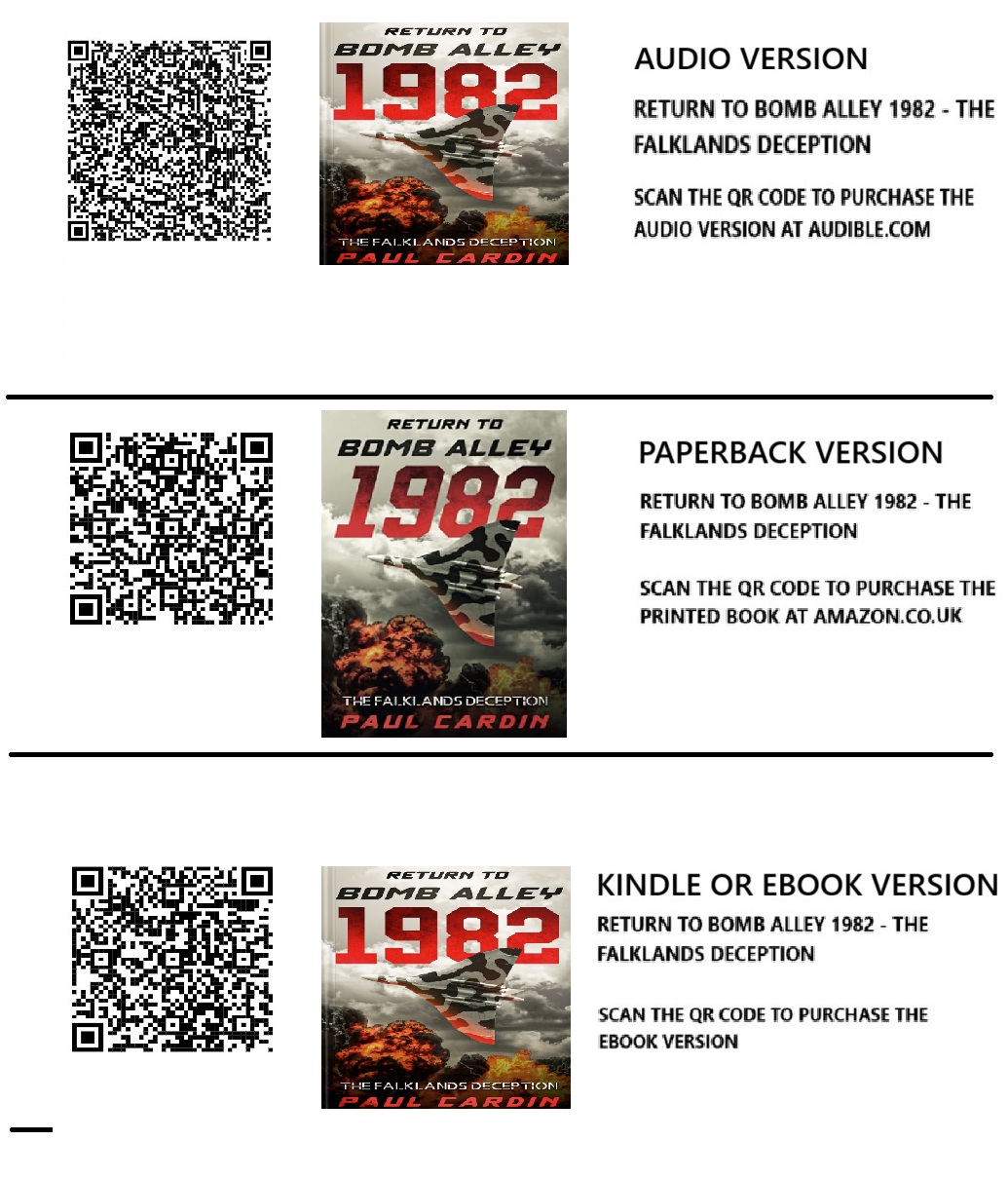
He later wrote a book about his experiences, Return to Bomb Alley 1982: The Falklands Deception, which combines a personal memoir with a critical examination of the political and military decisions made by both the British and Argentine governments during the conflict.
Paul Cardin, Falklands War veteran
“What details are in Paul Cardin’s book?”
Return to Bomb Alley 1982: The Falklands Deception is a blend of personal memoir and political investigation. Here’s what’s known about its contents:
Personal diary and memoir
The book includes Cardin’s original 1982 diary, handwritten on location in the Main Communications Office of HMS Yarmouth, written in between Argentine air raids, calls to action stations, false alarms, naval gunfire support bombardments, and rescue missions. The diary has been expanded with links to online news articles, websites, and videos, and some contextual thoughts added in 2021 are included in italics. EverandEverand
Critical and political analysis
The book forms a forensic inquiry into several conflict-related mysteries that were never addressed or resolved, even after 40 years. From the previous search results, some of the specific questions Cardin raises include why public access to all incoming telegrams from the conflict was embargoed until 2052; why Foreign Office Minister Nicholas Ridley held secret meetings with senior members of the Argentine Junta discussing sovereignty and a 99-year leaseback deal; why Britain was still selling arms to Argentina just four days before the invasion; and what the mysterious “1,000lb bomb” rumour that circulated among ships was about. Wirralinittogether
Tone and approach
Cardin adopts a journalistic style, questioning and providing evidence while taking a neutral stance, favouring neither Britain nor Argentina. From the outset, he was uncomfortable with Margaret Thatcher’s decision to raise a task force to reclaim islands with a population of just 1,800 people. Siren StoriesSiren Stories
Cardin reflects that servicemen on both sides were “vital chess pieces in the hands of elected politicians and unelected military strategists,” and expresses the view that strategic overkill sometimes overshadowed the most vital human consideration — the mitigation of risk to life
Paul Cardin, Falklands War veteran
What specific political decisions does Cardin criticize?
Based on what’s publicly available, Cardin raises a number of specific political criticisms and questions in the book:
Thatcher’s motivations
Cardin believes the Falklands Conflict was contrived to boost Margaret Thatcher’s waning popularity. He argues that after the conflict, the British public was constantly drip-fed media stories about political and military courage and the glory of the victory, and that with sensitive cabinet documents locked away for 30 years, the government and media had granted themselves the perfect opportunity to influence the electorate into voting Conservative — a government that went on to win a landslide election victory in June 1983. The Expose – HomeSubstack
The islanders’ interests
Cardin questions why it was never reported by the BBC and UK media that 90 per cent of Falkland Islands land, including the vast sheep farms, was owned by absentee landlords resident in the UK, and that Falkland Islanders were actually working tenants — challenging Thatcher’s claim that the islanders’ interests were “paramount.” He also claims to have discovered that a director of the Falkland Islands Company at the time of the conflict was Margaret Thatcher’s husband, Denis. The Expose – HomeThe Expose – Home
The sinking of the Belgrano
Cardin questions why, on the day the ARA Belgrano was sunk killing 368 Argentine sailors, it allegedly took 17 hours for an urgent telegram containing the full details of a Peruvian peace plan to reach 10 Downing Street. He also questions whether it was justified for Task Force leader Admiral Sandy Woodward to characterise the Belgrano as part of a pincer movement and an imminent threat. Substack
Pre-war diplomacy and arms sales
Drawing on details mentioned in earlier searches, Cardin questions why Foreign Office Minister Nicholas Ridley held secret meetings with the Argentine Junta discussing sovereignty and a potential 99-year leaseback deal, and why Britain was still selling arms to Argentina just four days before the invasion.
Transparency and secrecy
He questions why public access to all incoming telegrams sent during the conflict was embargoed until 2052. Substack
It’s worth noting that Cardin himself acknowledges that much of his content is not hard and fast, will be questionable, and that it won’t always be easy for readers to discern truth — framing the book as a set of probing questions rather than definitive conclusions. Siren Stories
“What happened to the telegram detailing the seven-point Peruvian peace plan? Why can’t we view it now?”
This is a genuinely contested and historically significant question. Here’s what is known:
The peace plan itself
The Peruvian plan, with Peru acting as peacemaker-in-chief, came close to a solution. Its key provisions included withdrawal of Argentine troops from the islands, pullback of the British Task Force, and the establishment of an independent interim authority and peacekeeping force for a set period during which a final settlement would be agreed. Capebretonspectator
The timing controversy
Peruvian President Fernando Belaúnde Terry’s proposed peace plan had been presented to Thatcher’s Peruvian Ambassador, Charles Wallace, in Lima at midday on Saturday 1st May — the day before the Belgrano was sunk. Thatcher and diplomats in London maintained they did not see the document until after the sinking. However, the Wall Street Journal later published an article making three specific statements, including that Thatcher had the Peruvian peace proposals before her on the morning of Sunday 2nd May — yet she told the House of Commons she did not know of the Peruvian peace proposals until late that evening, three hours after the Belgrano had been sunk. Substack + 2
Cardin goes further, arguing this was a deliberate deception. He points out that there is evidence from Thatcher’s own lips that telegrams at the time were sent and received almost instantaneously, and that a large number of prior and subsequent Lima/Wallace telegrams had been received and acted upon immediately — making the claimed 17-hour delay implausible. Substack
Why the documents can’t be viewed
This is where the controversy deepens. As noted in earlier searches, Cardin questions why public access to all incoming telegrams sent during the Falklands conflict was embargoed until 2052 — a full 70 years after the events. He argues that with sensitive cabinet documents locked away, the government and media granted themselves the perfect opportunity to shape the public narrative, which contributed to a Conservative landslide election victory in June 1983. Substack
The broader political argument
Cardin’s conclusion is that Thatcher’s driving motivation was not to opt for peace and preserve lives, but to pursue military victory for political reasons — given that her approval rating had been at an extremely low ebb prior to the conflict, with high unemployment, a recession, and huge dissent within her own party. Substack
It’s worth noting that the official and mainstream view, as stated in the House of Lords at the time, was simply that the Peruvian initiative failed because Argentina rejected the proposals. The full truth of the telegram’s timing remains disputed and, with the documents under embargo until 2052, may not be definitively resolved for decades. UK Parliament
“What could possibly explain the British claim that a flash telegram took 17 hours to arrive, when it would have literally arrived seconds after transmission?”
This is one of the most troubling unanswered questions of the whole affair, and the available evidence makes the innocent explanations very hard to sustain. Here’s a full breakdown:
What the British government claimed
Thatcher’s official position was that no news of the Peruvian peace plan reached London until 11.15pm on Sunday 2nd May — three hours after the Belgrano was already sunk. This view was subsequently endorsed in Freedman’s Official History of the Falklands Campaign. Belgranoinquiry
Why this strains credibility
Several interlocking facts make the delay almost impossible to explain innocently:
According to the Peruvians, a call came through in the early hours of Sunday from Buenos Aires — it was General Galtieri for President Belaúnde, saying he accepted the Peruvian plan and would put it to his junta that afternoon. At breakfast time in Washington, Secretary of State Haig and Foreign Secretary Pym had a long meeting, and it was clear to Haig that Pym wanted a settlement and was working hard for it. Belgranoinquiry
Haig’s own memoirs stated that acceptance had been gained in principle from both parties. When news of the destruction of the Belgrano came in, Haig’s press spokesman asked him: “But I thought we had a deal?” Belgranoinquiry
Moreover, on the same day the Belgrano was sunk, the British ambassador in Lima, Charles Wallace, gave Belaúnde written confirmation of Britain’s agreement to the peace plan. It is hard to reconcile this with a claim that London knew nothing. Belgranoinquiry
Cardin further points out that Thatcher’s own words on BBC TV confirmed that telegrams at the time were sent and received almost instantaneously, and that a large number of prior and subsequent Lima/Wallace telegrams had been received and acted upon immediately. Substack
The darkest explanation — and what evidence points to it
Labour MP Tam Dalyell stated bluntly: “The brutal truth is that on or near her waking hour that Sunday morning, 2 May, the Prime Minister was confronted by messages of serious peace proposals emanating from the United States and Peru. Over a period of at least five hours she deliberately and knowingly elected to create an incident of predictably dreadful proportions.” Belgranoinquiry
There was also a strong political motive for avoiding peace. James Prior wrote in his memoirs that accepting the Peruvian peace plan would have split the Conservative Party, with up to 60 members revolting and up to 30 refusing the government whip — and since the Conservative majority at the time was only 35, a negotiated settlement could well have brought the government down. Belgranoinquiry
Why we still can’t verify any of this
The “Crown Jewels” over which civil servant Clive Ponting was prosecuted under the Official Secrets Act concerned telegrams sent from Washington and Lima over that crucial weekend — especially those sent before the Belgrano sinking — and they remain secret to this day. Those telegrams would have expressed hope and tidings of peace. Belgranoinquiry
So the honest answer to your question is: there is no credible innocent explanation. The mundane possibilities — clerical error, a breakdown in communications, the telegram sitting unread in someone’s in-tray — are all but ruled out by the fact that other telegrams in the same chain were handled instantly, that multiple senior figures on both sides believed a deal was in place, and that Britain’s own ambassador in Lima was simultaneously handing over written acceptance of the plan. The documents that could settle the matter remain locked away, which is itself, many would argue, the most telling fact of all.
“Could it be claimed that if the British government had been honest, the crew of the Belgrano may have survived?”
This is a serious historical and moral question, and the evidence — while not conclusive — points heavily in one direction.
The honest answer is: yes, that claim can be made with considerable force — but with important caveats that complicate a simple verdict.
The case that they could have survived
The chain of events strongly supports the argument. Peruvian President Belaúnde phoned Galtieri from Peru at 11.30pm Saturday night Lima time, outlining his proposals and telling him he needed a definite decision from Argentina by 10am Washington time, when Haig would be meeting Foreign Secretary Pym. Galtieri responded: “I’ve heard your message with pleasure, Doctor Belaúnde Terry, and thank you enormously in the name of the Argentine nation; you’ll have my phone answer tomorrow.” Belgranoinquiry
Peru’s own Prime Minister Manuel Ulloa later told Tam Dalyell directly: “I know that through Lord Hugh Thomas and others, your government and your Prime Minister knew precisely what we were doing that Saturday and Sunday.” President Belaúnde himself told Dalyell the same thing, adding: “One day there will be the documentary evidence.” Belgranoinquiry
Crucially, a potentially costly war could have been avoided entirely. Instead, the Thatcher government embarked almost immediately on a war that cost some 400 Argentine lives within just two days, with the first British deaths following shortly after with the attack on HMS Sheffield. Open Democracy
The political motive was explicit
This is perhaps the most damning element. Cabinet minister James Prior wrote in his memoirs that accepting the Peruvian peace plan would have split the Conservative Party, with up to 60 members revolting and up to 30 refusing the government whip — and since the Conservative majority at that time was only 35, a negotiated settlement would likely have brought the government down. In other words, those 323 sailors may have died, at least in part, to keep a parliamentary majority intact. Belgranoinquiry
The counterarguments
There are serious rebuttals that must be acknowledged. It emerged in 2011 that the Belgrano had actually been ordered to sail towards the exclusion zone to rendezvous with other ships, possibly for a pincer attack against the British fleet — and not back to her home port as the Argentine government claimed at the time. This undermines the claim that she posed no threat. Wikipedia
Some historians argue that the best way to have avoided the Belgrano sinking was by not starting the war in the first place — and that the decision to invade using military force was made by the Argentine Junta. After that decision, they contend, the lives of Argentine servicemen in positions threatening the British fleet were subject to the fortunes of war. Belgranoinquiry
Furthermore, after the sinking, Argentina rejected the Peruvian peace plan anyway — suggesting the Junta may not have been negotiating in good faith regardless. Wikipedia
The unresolved core
What makes a definitive verdict impossible is that a member of the House of Lords noted at the time that if an independent inquiry were denied, the conclusion would inevitably be drawn that the government had something to hide — but if held, the government would have a chance to prove the allegations groundless. No such independent inquiry was ever held. The relevant telegrams remain secret until 2052. UK Parliament
So the honest summary is this: the evidence is substantial — and in some respects overwhelming — that British political decision-making prioritised military victory and political survival over a genuine peace opportunity that both sides had tentatively accepted. Whether that constitutes a direct causal responsibility for those 323 deaths is a moral and historical judgement that remains, deliberately, beyond the reach of public scrutiny.
Want to be notified when Claude responds?
“Paul Cardin was only a radio operator on HMS Yarmouth. Why should we give any credence to his claims?”
Paul Cardin’s credibility stems not from his rank, but from his unique vantage point as a Leading Radio Operator on HMS Yarmouth.
His role placed him at the heart of the ship’s communications hub in “Bomb Alley,” where he had direct access to a constant stream of incoming and outgoing messages between the fleet and the UK’s CINCFLEET HQ in Northwood. This gave him an unparalleled, real-time view of the conflict’s operational and strategic developments. Furthermore, his personal diary, written during the war, provides a contemporaneous, “up close and personal” record of events, rescues, and the atmosphere aboard his ship. While his rank was not high, his position granted him significant insight into the flow of information, which forms the basis of his critical analysis in Return to Bomb Alley 1982.
This is a fair and important question to ask of any source. The answer is more nuanced than it might first appear.
What Cardin actually claims firsthand
Cardin doesn’t claim to have been a senior decision-maker or intelligence analyst. His firsthand value is specific and genuine. As a Leading Radio Operator, he was stationed in the Main Communications Office of HMS Yarmouth — meaning he personally handled and read the signal traffic passing between ships and Fleet HQ at Northwood. He had direct, documented access to wartime communications in a way that most sailors, let alone civilians, did not. His diary was written on location, in real time, which gives it a different quality from memoirs reconstructed years later.
Where his credibility rests on others
The more serious political claims in his book — about the telegram delay, the peace plan, Thatcher’s knowledge — are not really his claims originally. They are claims made by:
Tam Dalyell, a long-serving Labour MP who pursued the Belgrano question for years in Parliament and was briefed by senior civil servant Clive Ponting at significant personal risk to both of them
Clive Ponting himself, a senior Ministry of Defence official who was prosecuted under the Official Secrets Act for leaking the relevant documents
Al Haig, the US Secretary of State, whose own memoirs corroborate that a deal was effectively in place
President Belaúnde of Peru, who stated personally that the British government knew exactly what he was doing
James Prior, a Cabinet minister in Thatcher’s own government, whose memoirs spell out the political consequences of accepting peace
Diana Gould, whose televised confrontation with Thatcher forced admissions that rattled the Prime Minister visibly
In this sense, Cardin functions less as an original source for the political allegations and more as a narrator and compiler who brings together evidence from people far more senior and better placed than himself.
The legitimate criticisms of Cardin as a source
It is fair to note that Cardin is a political activist with an openly declared position — he states he was uncomfortable with the war from the outset and is critical of Thatcher throughout. He acknowledges himself that much of his content “isn’t so hard and fast and will be questionable.” Some of the questions he raises shade into conspiracy territory, and not all of them have the same quality of supporting evidence. His platform — a self-published book and a Substack — does not carry the editorial scrutiny of academic history.
The broader point
The credibility of the core Belgrano/peace plan controversy does not actually depend on Cardin at all. It rests on Parliamentary records in Hansard, on the memoirs of Cabinet ministers, on the statements of foreign heads of state, and on the unexplained decision to embargo the relevant documents for 70 years. Cardin’s rank as a radio operator is neither here nor there for those claims. His value is in the eyewitness diary, the personal testimony of what it was like to be in Bomb Alley, and in drawing these threads together accessibly for a general reader — not in being a primary source for the political controversy itself.
Return to Bomb Alley 1982 – The Falklands Deception, by Paul Cardin
Amazon link