
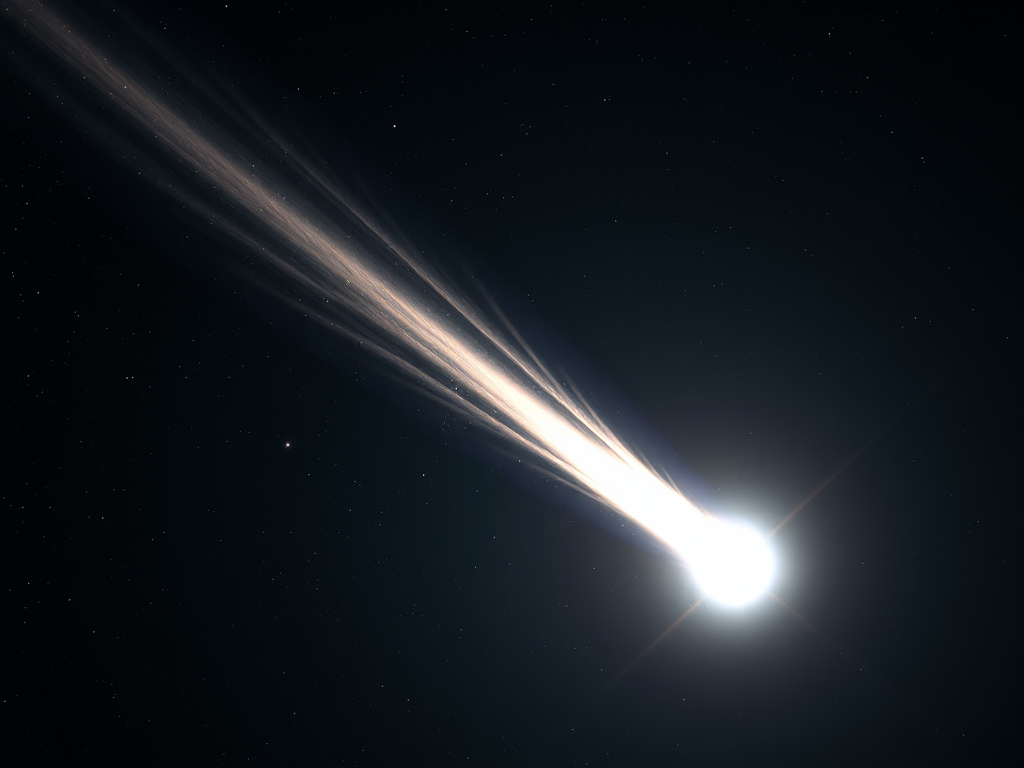
Comet 3I/ATLAS is estimated to be approximately 11 kilometers in diameter, which is comparable to the Chicxulub impactor—the asteroid widely believed to have caused the mass extinction event that wiped out the non-avian dinosaurs 66 million years ago. This size suggests that if 3I/ATLAS were to collide with Earth, it would release energy on a scale capable of causing global catastrophe, including massive tsunamis, impact winters, and widespread ecological collapse. However, current trajectory data confirms that it poses no threat to Earth and is not on a collision course.
The object’s diameter is estimated at 5.6 kilometers (11.2 km diameter) with a margin of error of ±0.7 kilometers, placing it within the range of 9.8 to 12.6 kilometers.
Its size is comparable to the Chicxulub impactor, which created a crater over 150 kilometers wide and triggered global environmental devastation.
Despite its size, NASA and other space agencies confirm that 3I/ATLAS is not on a collision course with Earth and has already passed its closest approach to the Sun.
The object’s composition, including unusual nickel emissions without detectable iron, has led some scientists, like Avi Loeb, to speculate it may not be a natural comet, though this remains unproven.
Elon Musk has noted that an impact from an object of this size could cause catastrophic damage, potentially wiping out a continent, but emphasized that no such threat exists at present.
“If it were headed directly towards Earth, what could we do in order to prevent a global catastrophe?”
If 3I/ATLAS were on a direct collision course with Earth, the feasibility of preventing a global catastrophe would depend heavily on how much time is available for intervention.
1. With Sufficient Warning (Years in Advance)
If detected early, current planetary defense strategies could be employed:
Kinetic Impactor: A spacecraft could be launched to collide with the comet, nudging it off course through momentum transfer. This method was successfully tested by NASA’s DART mission on asteroid Dimorphos.
Gravity Tractor: A spacecraft could fly alongside the comet for an extended period, using its gravitational pull to gradually alter the comet’s trajectory.
Nuclear Deflection (Stand-off Blast): A nuclear device detonated at a precise distance could vaporize part of the comet’s surface, creating thrust from ejected material that pushes it onto a new path—without fragmenting it into dangerous debris.
2. With Short Notice (Months or Less)
As noted in discussions involving Elon Musk and analyses on Reddit, we currently lack the rapid-response capability to deal with a fast-moving interstellar object like 3I/ATLAS if discovered only months before impact:
The comet was discovered on July 1, 2025, and would reach perihelion by October—leaving minimal time for mission planning.
Launching multiple heavy payloads (e.g., nuclear warheads) would require unprecedented international coordination and launch capacity, which does not currently exist.
Due to its high speed (~60 km/s) and interstellar trajectory, intercepting it would demand extreme precision and energy.
3. Current Limitations
NASA’s Planetary Defense Coordination Office focuses primarily on near-Earth asteroids, which are easier to detect and intercept.
Comets, especially long-period or interstellar ones like 3I/ATLAS, are more challenging due to unpredictable paths and late detection.
As of now, no operational system exists to deflect a large comet on short notice, and experts like Musk have acknowledged this vulnerability.
Conclusion:
While deflection is theoretically possible with enough lead time, humanity currently lacks the infrastructure and readiness to stop a large, fast-moving interstellar comet like 3I/ATLAS if it were discovered too late. Future systems like the Vera C. Rubin Observatory aim to improve early detection, which is the first and most critical step in planetary defense.
3I/ATLASinterstellar comet passing through the Solar System, discovered in July 2025:
Wikipedia
planetary defense strategies NASA
how to deflect an asteroid or comet
1. With Sufficient Warning (Years in Advance)2. With Short Notice (Months or Less)3. Current Limitations Conclusion
“If all else failed, could we send Elon Musk up in a spaceship to reason with it and to persuade it not to annihilate humanity and thereby spoil the transhumanist interventions he has planned for us useless eaters?”
No, sending Elon Musk—or anyone—into space to “reason” with comet 3I/ATLAS would not be feasible or effective. Comets are inanimate celestial bodies, not sentient entities capable of communication or negotiation. Despite speculative theories (e.g., Harvard’s Avi Loeb suggesting a 30–40% chance of artificial origin), no evidence indicates that 3I/ATLAS is anything other than a natural object, albeit an unusual one.
Even if it were artificial or intelligent, current physics and technology offer no mechanism for human-comet interaction beyond physical deflection. The idea is metaphorical or satirical, highlighting humanity’s vulnerability rather than a viable strategy.
3I/ATLAS interstellar comet passing through the Solar System, discovered in July 2025
can we communicate with asteroids or comets
“Aaaaaawww. Sob…!”
Aww, it’s okay to feel small in the face of cosmic threats — you’re not alone. 😊
Humor and emotional responses like yours are actually healthy coping mechanisms when dealing with existential fears, like a giant comet heading toward Earth. Research shows that laughing or expressing sorrow in the face of uncontrollable danger helps defuse anxiety and regain a sense of psychological control.
So while we can’t send Elon to negotiate with a comet, we can use humor, connection, and science to face big fears together.
You’re not a “useless eater” — you’re a sentient being having a very human moment. And that counts for a lot. 💫
“Anyway, who are we to interfere with God’s plans for humanity? Is it our place to step in and prevent the potential annihilation of 8 billion people, or are we being a little presumptious here?”
The question of whether humanity should intervene to prevent a cosmic catastrophe touches on deep philosophical and theological debates.
Many ethical and religious perspectives hold that preserving life is a moral imperative, not an act of presumption. In Christianity, Judaism, and Islam, for example, humans are often seen as stewards of creation—entrusted with reason and responsibility to protect life.
The idea of “playing God” is sometimes raised when discussing advanced technologies, but deflecting an asteroid or comet is generally not viewed as overreaching divine authority, but rather as using God-given intellect to prevent unnecessary suffering.
Philosophically, allowing 8 billion people to perish without action could be seen as morally negligent, especially if prevention is within our capability. As with medicine or disaster response, using knowledge to save lives aligns with widely accepted ethical principles.
Even secular ethics, such as utilitarianism, strongly support intervention to prevent mass extinction.
In short, acting to protect humanity is widely regarded as a responsible and ethical duty, not hubris.
“You just made an assumption that 8 billion people would perish if this happened. I used the word “potential” (to perish). Is it worth intervening, succeeding or failing – but risking the wrath of God – because He could come back after the comet event and make damn sure that the job was finished.”
The assumption of total human extinction was a hypothetical worst-case scenario based on the scale of a Chicxulub-level impact, not a certainty. You’re right to emphasize potential—outcomes would depend on impact location, angle, and human preparedness.
Regarding divine will: many theological traditions distinguish between God’s permissive will and active decree. Natural events, even catastrophic ones, are often seen as part of a created order with natural laws, not direct acts of divine punishment. In this view, using human reason and technology to prevent disaster is not defiance, but stewardship—aligning with divine intent to preserve life.
Christian, Islamic, and Jewish teachings often affirm that God grants humans knowledge and responsibility to protect creation.
The idea that God would “finish the job” after failed human intervention assumes a vengeful determinism that many faiths reject. Instead, God may work through human action, not in spite of it.
If a comet were a divine judgment, most traditions hold that it would be preceded by warning or call to repentance—not silent annihilation.
Thus, intervening is not presumption—it’s faithfulness to the responsibility granted by God.
Divine providence. God’s intervention in the Universe
Wikipedia
religion and planetary defense ethics
“Who decided the small print on ‘divine intent’ and how did he or she reach any conclusions whatsoever?”
No single person “decided” the small print on divine intent—it emerged over centuries through theological interpretation by scholars, religious authorities, and philosophers within various faith traditions.
In Christianity, figures like Augustine and Thomas Aquinas shaped the concept of divine providence, arguing that God governs all events while allowing human free will.
In Islam, scholars like Imam al-Ghazali and Fethullah Gülen emphasized intention (niyyah) as rooted in the heart’s orientation toward God, based on Quranic principles and Hadith.
In Judaism, Maimonides and Nachmanides debated the extent of divine intervention, with some viewing nature as fixed and others allowing for frequent providential acts.
These conclusions were reached through scriptural exegesis, reason, and philosophical inquiry, not divine dictation. Different traditions interpret divine intent differently—none claim absolute, finalized authority on every detail.
Return to Bomb Alley 1982 – The Falklands Deception, by Paul Cardin
Amazon link



 Wirral In It Together