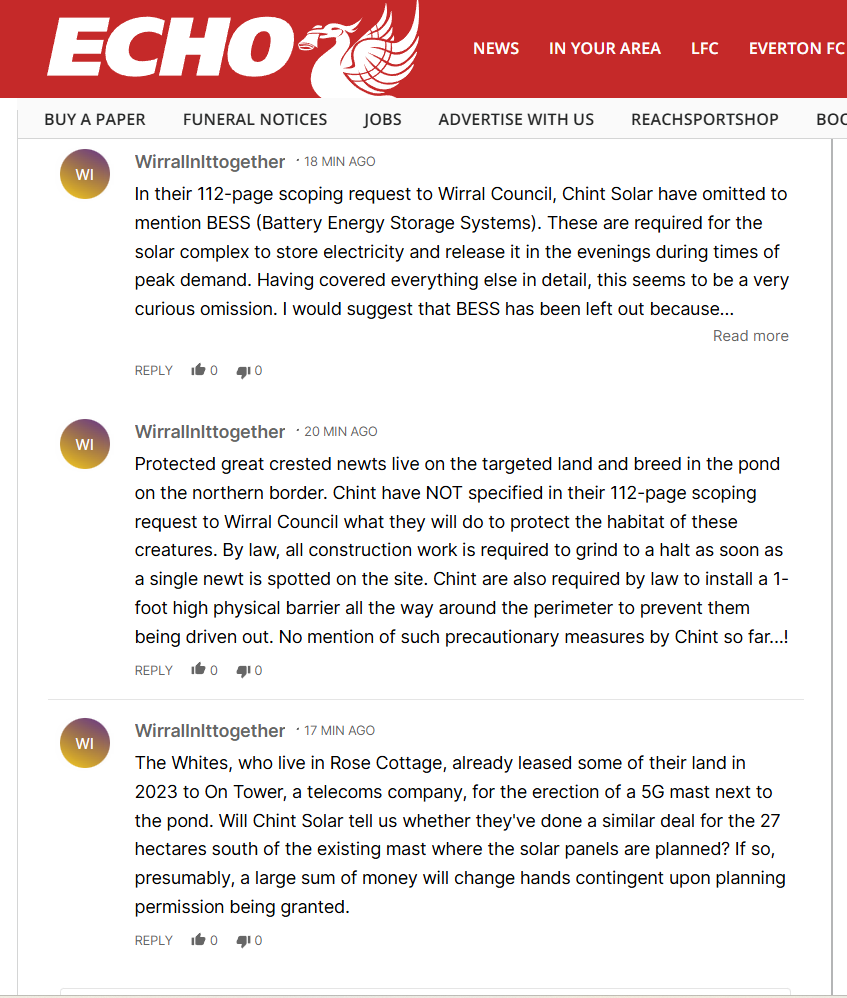
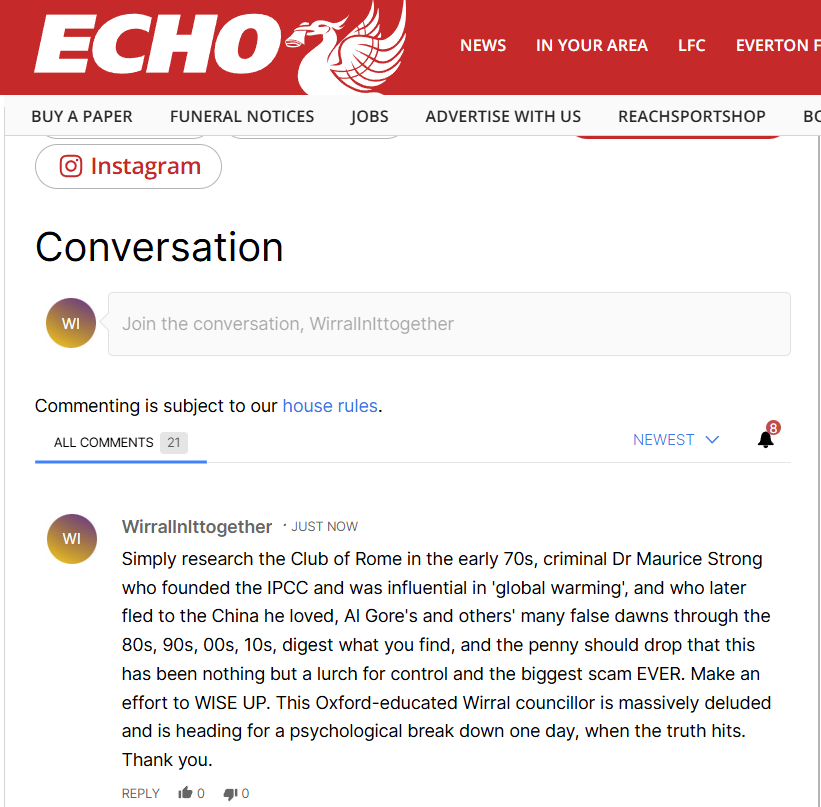
Q. How deluded can one person be? A. THIS deluded … Combating Climate Disinformation: Three Hopeful Signs as We Head into COP30 – Union of Concerned Scientists

https://blog.ucs.org/kate-cell/combating-climate-disinformation-three-hopeful-signs-as-we-head-into-cop30/


Return to Bomb Alley 1982 – The Falklands Deception, by Paul Cardin

Amazon link


http://paulcardin.substack.com

Posted in Uncategorized | Leave a comment

The Dangers of Data Centres. Linked to Deeply Unpopular Digital ID #NoToDigitalID

https://x.com/PaulCardin79469/status/1981086899444789402


Return to Bomb Alley 1982 – The Falklands Deception, by Paul Cardin

Amazon link


http://paulcardin.substack.com

Posted in Uncategorized | Leave a comment

What Happened in Tianenmen Square? | The Corbett Report

https://corbettreport.substack.com/p/what-happened-in-tiananmen-square?utm_source=post-email-title&publication_id=725827&post_id=177353341&utm_campaign=email-post-title&isFreemail=true&r=b9xiw&triedRedirect=true&utm_medium=email


Posted in Uncategorized | Leave a comment

Paste this prompt into ChatGPT and get a complete business plan in 60 seconds …

Including 3-year financials.

This is what $5K consultants used to charge for.

The prompt:

  1. You are an expert business strategist and financial modeler. Given the following inputs:  
  2. – Business name: {NAME}  
  3. – Industry / product description: {DESCRIPTION}  
  4. – Target customers: {TARGET_CUSTOMERS}  
  5. – Key assumptions (growth rate, conversion, ARPU, costs): {ASSUMPTIONS}  
  6.  
  7. Produce a full investor-ready business plan with these sections: 
  8.  
  9. 1) Executive summary (one paragraph) 
  10. 2) Company overview (mission, value prop, product) 
  11. 3) Market analysis (TAM/SAM/SOM estimates, target customer personas, top competitors, trends/opportunities) 
  12. 4) Business model & monetization (pricing, unit economics) 
  13. 5) Go-to-market: marketing & sales strategy (channels, sample 90-day plan) 
  14. 6) Financial projections: 3-year P&L, cash flow summary, and break-even analysis with clear assumptions and formulas (present numbers in table format) 
  15. 7) Risk analysis and mitigation 
  16. 8) Implementation timeline with milestones for 12 months (quarterly OKRs). 
  17.  
  18. Keep the plan concise and formatted with headings. If any input is missing, note the assumption you used. 
  19. “` 
  20.  
  21. What it generates: 
  22.  
  23. Everything investors want to see: 
  24.  
  25. ✅ Executive summary 
  26. ✅ Market analysis (TAM/SAM/SOM) 
  27. ✅ Competitor landscape 
  28. ✅ Unit economics 
  29. ✅ 90-day GTM plan 
  30. ✅ 3-year P&L with tables 
  31. ✅ Cash flow projections 
  32. ✅ Break-even analysis 
  33. ✅ Risk mitigation 
  34. ✅ 12-month implementation roadmap 
  35.  
  36. In under a minute. 
  37.  
  38. How to use it: 
  39.  
  40. Fill in the brackets: 
  41.  
  42. {NAME} = Your company name 
  43. {DESCRIPTION} = “AI-powered accounting software for freelancers” 
  44. {TARGET_CUSTOMERS} = “Freelancers earning $50K-$200K/year” 
  45. {ASSUMPTIONS} = Your numbers 
  46.  
  47. Pro tip for assumptions: 
  48.  
  49. Paste a simple table after the prompt: 
  50. “` 
  51. Year 0 revenue: $0 
  52. Monthly growth rate: 5% 
  53. CAC: $100 
  54. ARPU: $30/month 
  55. Churn: 5%/month 
  56. Operating costs: $10K/month 

ChatGPT will use these to build realistic projections.

What makes this prompt powerful:

Most people ask ChatGPT: “Write me a business plan.”

And get generic garbage.

This prompt is structured like a consultant would think:

  1. Clear role assignment (“expert business strategist”)
  2. Specific inputs required
  3. Exact output format
  4. Financial modeling instructions
  5. Assumption handling

It forces rigor.

The financial projections are legit:

ChatGPT will:

  • Calculate monthly recurring revenue
  • Project customer acquisition
  • Model churn impact
  • Estimate cash burn
  • Determine break-even month

With actual formulas shown.

You can verify the math.

Adjust the assumptions.

Re-run instantly.

Where this actually helps:

Fundraising prep: Get the structure right before hiring a consultant

Pitch deck support: Pull sections directly into slides

Internal planning: Align team on growth assumptions

Accelerator applications: Most want a basic plan

Reality check: See if your idea makes financial sense

Where it falls short:

It can’t:

  • Validate your market research
  • Know your actual competitors
  • Predict real conversion rates
  • Replace due diligence

It’s a starting point, not a finished product.

But it’s a REALLY good starting point.

The old way:

Hire consultant: $5K-$15K Wait time: 2-4 weeks Revisions: Painful Ownership: You paid but they “own” the model

The new way:

Paste prompt: Free Wait time: 60 seconds Revisions: Instant Ownership: 100% yours

Customizing for different business types:

SaaS: Add “focus on MRR, LTV:CAC ratio, and expansion revenue”

E-commerce: Add “include inventory costs, shipping margins, and return rates”

Marketplace: Add “two-sided growth dynamics and take rate optimization”

Services: Add “utilization rates and service delivery costs”

Just append to the prompt.

The iteration workflow:

  1. Run the prompt with initial assumptions
  2. Review the output
  3. Adjust assumptions based on reality
  4. Re-run in 30 seconds
  5. Repeat until numbers make sense

This is how you pressure-test your idea.

Real example outputs:

I tested this with:

“AI resume builder for job seekers”

It generated:

  • TAM of $2.3B (validated against real data)
  • Competitive analysis of 8 players
  • Pricing strategy ($29-$99/month)
  • Break-even at month 14 with assumptions shown

Took 45 seconds.

Why this matters now:

Investors are seeing 100+ decks per week.

The ones with clear financials get meetings.

The ones with “hockey stick projections” and no math get ignored.

This prompt forces you to:

  • Think through unit economics
  • Model realistic growth
  • Identify risks early
  • Show you’ve done the work

Even if AI helped.

The limitation nobody mentions:

ChatGPT will be optimistic.

It assumes:

  • Conversion rates work
  • Churn stays low
  • Growth is consistent
  • Competition doesn’t react

Real life is messier.

So multiply your timeline by 1.5x.

Cut your revenue projections by 30%.

That’s closer to reality.

The ethical question:

Should you tell investors AI generated this?

My take: No, because you’re not claiming AI did the thinking.

You:

  • Provided the assumptions
  • Validated the logic
  • Own the strategy

AI just formatted it faster than Excel would.

That’s fine.

Where to go from here:

Use this prompt to:

  1. Draft your initial plan (60 seconds)
  2. Validate assumptions with real research
  3. Adjust numbers based on market data
  4. Share with advisors for feedback
  5. Refine before showing investors

It’s a tool, not a shortcut.

But it’s a REALLY good tool.

The future of business planning:

AI handles structure and math.

Humans handle strategy and validation.

The founders who win will use both.

The ones who think AI replaces thinking will fail.


Return to Bomb Alley 1982 – The Falklands Deception, by Paul Cardin

Amazon link


http://paulcardin.substack.com

Posted in Uncategorized | Tagged , , , , | Leave a comment

THE DIGITAL ID WON’T MAKE US FREE …

#NoToDigitalID


Posted in Uncategorized | Leave a comment

[VIDEO] The UN’s Hidden Agenda. Data Centres and Global Control #NoToDigitalID

#NoToDigitalID

https://x.com/PaulCardin79469/status/1982901580665106793


Yes, there are private company plans to erect new data centres within the Liverpool City Region, including the Wirral. Liverpool City Region Data Centres (LCRDC), a company founded by Matt Wilson and part of Baltic Broadband, is actively expanding its network of small-scale data centres across Liverpool, Sefton, Knowsley, St Helens, Halton, and the Wirral. This expansion includes multiple micro and edge data centres designed to support 5G applications, media streaming, driverless cars, drone deliveries, and the Internet of Things by placing infrastructure deep within communities.

Specifically, LCRDC has launched several facilities, including the Liverpool City Queen’s Data Centre in the Baltic Triangle  , the Liverpool One Micro Data Centre in the city centre  , and the Liverpool City Castle Micro Data Centre located in the former moat of Liverpool Castle. Another micro data centre is planned near Crosby, and a new facility is under construction at the Wallasey Water Tower, which is expected to launch in Q4 2025. These developments are part of a broader strategy to provide edge and micro colocation services across the region, including the Wirral.

Additionally, the Liverpool City Region Combined Authority has been working on initiatives like the LCR Connect network to improve digital connectivity, which supports the growth of such infrastructure. While the region is seeing significant private investment in data centres, the expansion is driven by both private enterprise and public-private partnerships aimed at enhancing the region’s digital infrastructure.


Return to Bomb Alley 1982 – The Falklands Deception, by Paul Cardin

Amazon link


http://paulcardin.substack.com

Posted in Uncategorized | Leave a comment

[VIDEO] Digital Identity and the Future of Privacy

https://x.com/PaulCardin79469/status/1982901580665106793


Yes, there are private company plans to erect new data centres within the Liverpool City Region, including the Wirral. Liverpool City Region Data Centres (LCRDC), a company founded by Matt Wilson and part of Baltic Broadband, is actively expanding its network of small-scale data centres across Liverpool, Sefton, Knowsley, St Helens, Halton, and the Wirral. This expansion includes multiple micro and edge data centres designed to support 5G applications, media streaming, driverless cars, drone deliveries, and the Internet of Things by placing infrastructure deep within communities.

Specifically, LCRDC has launched several facilities, including the Liverpool City Queen’s Data Centre in the Baltic Triangle  , the Liverpool One Micro Data Centre in the city centre  , and the Liverpool City Castle Micro Data Centre located in the former moat of Liverpool Castle. Another micro data centre is planned near Crosby, and a new facility is under construction at the Wallasey Water Tower, which is expected to launch in Q4 2025. These developments are part of a broader strategy to provide edge and micro colocation services across the region, including the Wirral.

Additionally, the Liverpool City Region Combined Authority has been working on initiatives like the LCR Connect network to improve digital connectivity, which supports the growth of such infrastructure. While the region is seeing significant private investment in data centres, the expansion is driven by both private enterprise and public-private partnerships aimed at enhancing the region’s digital infrastructure.


Return to Bomb Alley 1982 – The Falklands Deception, by Paul Cardin

Amazon link


http://paulcardin.substack.com


Posted in Uncategorized | Leave a comment

Surveillance and Control in the Digital Age

#NoToDigitalID

https://x.com/PaulCardin79469/status/1982900858355626118


Yes, there are private company plans to erect new data centres within the Liverpool City Region, including the Wirral. Liverpool City Region Data Centres (LCRDC), a company founded by Matt Wilson and part of Baltic Broadband, is actively expanding its network of small-scale data centres across Liverpool, Sefton, Knowsley, St Helens, Halton, and the Wirral. This expansion includes multiple micro and edge data centres designed to support 5G applications, media streaming, driverless cars, drone deliveries, and the Internet of Things by placing infrastructure deep within communities.

Specifically, LCRDC has launched several facilities, including the Liverpool City Queen’s Data Centre in the Baltic Triangle  , the Liverpool One Micro Data Centre in the city centre  , and the Liverpool City Castle Micro Data Centre located in the former moat of Liverpool Castle. Another micro data centre is planned near Crosby, and a new facility is under construction at the Wallasey Water Tower, which is expected to launch in Q4 2025. These developments are part of a broader strategy to provide edge and micro colocation services across the region, including the Wirral.

Additionally, the Liverpool City Region Combined Authority has been working on initiatives like the LCR Connect network to improve digital connectivity, which supports the growth of such infrastructure. While the region is seeing significant private investment in data centres, the expansion is driven by both private enterprise and public-private partnerships aimed at enhancing the region’s digital infrastructure.


Return to Bomb Alley 1982 – The Falklands Deception, by Paul Cardin

Amazon link


http://paulcardin.substack.com

Posted in Uncategorized | Leave a comment

The UK of the future? Your face, name, and address – appearing on huge billboards. SHAMED. #NoToDigitalID


Yes, there are private company plans to erect new data centres within the Liverpool City Region, including the Wirral. Liverpool City Region Data Centres (LCRDC), a company founded by Matt Wilson and part of Baltic Broadband, is actively expanding its network of small-scale data centres across Liverpool, Sefton, Knowsley, St Helens, Halton, and the Wirral. This expansion includes multiple micro and edge data centres designed to support 5G applications, media streaming, driverless cars, drone deliveries, and the Internet of Things by placing infrastructure deep within communities.

Specifically, LCRDC has launched several facilities, including the Liverpool City Queen’s Data Centre in the Baltic Triangle  , the Liverpool One Micro Data Centre in the city centre  , and the Liverpool City Castle Micro Data Centre located in the former moat of Liverpool Castle. Another micro data centre is planned near Crosby, and a new facility is under construction at the Wallasey Water Tower, which is expected to launch in Q4 2025. These developments are part of a broader strategy to provide edge and micro colocation services across the region, including the Wirral.

Additionally, the Liverpool City Region Combined Authority has been working on initiatives like the LCR Connect network to improve digital connectivity, which supports the growth of such infrastructure. While the region is seeing significant private investment in data centres, the expansion is driven by both private enterprise and public-private partnerships aimed at enhancing the region’s digital infrastructure.


RReturn to Bomb Alley 1982 – The Falklands Deception, by Paul Cardin

Amazon link


http://paulcardin.substack.com

Posted in Uncategorized | Leave a comment

[VIDEO] The Dangers of Digital ID and 5G Masts


Yes, there are private company plans to erect new data centres within the Liverpool City Region, including the Wirral. Liverpool City Region Data Centres (LCRDC), a company founded by Matt Wilson and part of Baltic Broadband, is actively expanding its network of small-scale data centres across Liverpool, Sefton, Knowsley, St Helens, Halton, and the Wirral. This expansion includes multiple micro and edge data centres designed to support 5G applications, media streaming, driverless cars, drone deliveries, and the Internet of Things by placing infrastructure deep within communities.

Specifically, LCRDC has launched several facilities, including the Liverpool City Queen’s Data Centre in the Baltic Triangle  , the Liverpool One Micro Data Centre in the city centre  , and the Liverpool City Castle Micro Data Centre located in the former moat of Liverpool Castle. Another micro data centre is planned near Crosby, and a new facility is under construction at the Wallasey Water Tower, which is expected to launch in Q4 2025. These developments are part of a broader strategy to provide edge and micro colocation services across the region, including the Wirral.

Additionally, the Liverpool City Region Combined Authority has been working on initiatives like the LCR Connect network to improve digital connectivity, which supports the growth of such infrastructure. While the region is seeing significant private investment in data centres, the expansion is driven by both private enterprise and public-private partnerships aimed at enhancing the region’s digital infrastructure.


RReturn to Bomb Alley 1982 – The Falklands Deception, by Paul Cardin

Amazon link


http://paulcardin.substack.com

Posted in Uncategorized | Leave a comment